The Path of Compassion: A Biography of Hor shul Khenpo Gelek Palsang Rinpoche
The Path of Compassion: A Biography of Hor shul Khenpo Gelek Palsang Rinpoche — Part Two: Hor shul Khenpo Gelek Palsang Rinpoche — Chapter Two: Learning and Growth
From childhood, Hor shul Khenpo Gelek Palsang Rinpoche studied with the elder Khenpos and treasure revealers of Hor shul Monastery, learning to construct many kinds of maṇḍalas, use various ritual implements, form hundreds of mudrās, make many kinds of tormas, and perform various vajra dances. What took others from one to several months to learn, he mastered in only a few days. The Khenpo memorized an astonishing quantity of scriptures and treatises, many of which he could memorize in a single day. He learned without difficulty and grasped the essential points with ease. Many great masters directly witnessed his extraordinary intelligence and showered him with praise. When he was still very young, the Khenpo went to many fierce places—charnel grounds, springs, and dangerous sites—and practiced Chöd throughout the night. When performing rites for the deceased, immense white vultures, true manifestations of ḍākinīs, appeared many times to consume the bodies, and many people witnessed this directly.
When Great Khenpo Qiaq Rinpoche—the sole heart-son of Tulku Eba and the commonly recognized joint incarnation of Rongzom Paṇḍita and Milarepa—began turning the great Dharma wheel by establishing the Institute of Sūtra and Tantra in Hor shul, he repeatedly sent people with letters specifically inviting Hor shul Khenpo Gelek Palsang Rinpoche to come and study. At first the family did not agree, because it was too far from their pastoral home and inconvenient. Finally, Qiaq Rinpoche invited Hor shul Khenpo Gelek Palsang Rinpoche’s grandfather to a meal and said, “This child in your family is no ordinary boy. He is naturally intelligent and has excellent roots of virtue. Coming to me will be of great help to him in the future.” He then personally approached Hor shul Khenpo Gelek Palsang Rinpoche’s maternal uncle, Great Khenpo Qiupeng of Dzogchen Monastery, and said, “Please persuade the family. I am old now and can no longer do many things. Ask your nephew to come and live here permanently. I have heard that from childhood he has mastered many generation- and completion-stage liturgies. In the future I will have him serve as the vajra master here, bestowing empowerments and transmitting the Dharma.”
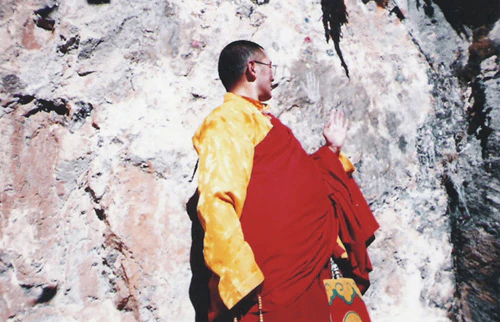
After the family consented, Hor shul Khenpo Gelek Palsang Rinpoche studied before his root guru from lifetime after lifetime, Qiaq Rinpoche, relying upon him through the three means of pleasing him—through Dharma practice, service with body, speech, and mind, and material offerings—and received most of the sutric and tantric teachings. Qiaq Rinpoche held nothing back and poured the entire contents of his treasury into Hor shul Khenpo Gelek Palsang Rinpoche. These teachings included the profound essence of the Early Translation esoteric teachings: Rongzom Paṇḍita’s General Meaning of the Mahāyāna and Heart Essence of Dzogchen; Longchenpa’s Three Great Resting Places of Dzogchen, Commentary on the Great Magical Net, Three Self-Liberations of Dzogchen, Explanation of the Great Magical Net: Dispelling Darkness in the Ten Directions, and Seven Treasuries of Dzogchen; and Jigme Lingpa’s Wisdom Guru of Dzogchen with its guidance, extending through the generation stage and completion stage to the Atiyoga of Dzogchen. During this period he also repeatedly heard Tulku Eba Rinpoche’s commentary on the Ornament of Clear Realization, composed when he directly beheld Bodhisattva Maitreya, and the explanation of the Beacon of Certainty called A Comparison of Views. In 1986, before Jigme Phuntsok Rinpoche, former head of the Larung Gar Five Sciences Buddhist Institute and revered as a second Buddha, he received the great empowerment of the Kālacakra Tantra, the Collection of the Treasury of Teachings, the empowerment of Longchenpa’s Four Heart Essences, the essence of the most secret Pith Instruction Section of Dzogchen, and the empowerments and oral transmissions for the two volumes of Jigme Lingpa’s Longchen Nyingthig. From Master Mencuo he received the empowerment lineage of the principal treasure teachings of the southern Nyingmapa tradition, including those of the great translator Minling Terchen of Mindrolling Monastery, and heard the pith-instruction guidance of Shabkar Tsokdruk Rangdröl’s Teaching on Dzogchen: The Garuḍa Spreading Its Wings. From the accomplished Nyingmapa master Xigong Mazhi Rinpoche he received uncommon complete treasure cycles such as the Eight Great Herukas, as well as the complete treasure cycle of his previous life, “Xiangqiu Langba,” together with empowerments, oral transmissions, and pith-instruction guidance. At the former Hor shul Monastery, from Ongzhi Rinpoche, who had returned from India after living abroad, he received the empowerments, oral transmissions, and pith instructions of all the profound treasures of Namchö Mingyur Dorje and Ratna Lingpa, the two principal treasure revealers of the Nyingma and Palyul traditions. He received the empowerment of the Sok tradition of the Nyingma scripture Nine Deities of Purity; the lineage of the fire offering from that teacher’s Uprooting the Hells; the brief text of the Nyang treasure Red Wrathful One; most of Great Compassionate Avalokiteśvara Taming Beings; all the empowerments and brief lineage of Chöwang’s Gathering of the Guru; the empowerment and some transmissions of the Essential Collection of Great Compassion; all the empowerments and lineage of Vajrakīlaya: Sharp Sword; some of the Nyezé cycle of Wrathful Vajrapāṇi; some transmissions of Pema Lingpa’s Longevity Guidance: Vajra Tress; the empowerment of Heart Essence of the Vidyādharas; the Longevity empowerment; the guidance and lineage of Guru Yoga: A Rainfall of Blessings; and the empowerment and root guidance of Vajrasattva, among others.
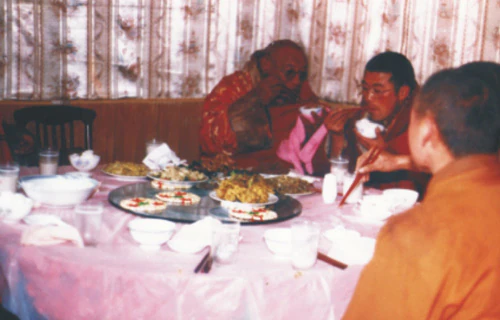
From the Kagyu master Sangjie Danzeng Rinpoche, the Khenpo received instructions. He received the empowerments and lineages of the Dru tradition’s Amitāyus: Outer Practice of the Solitary Deity, Most Secret Gongkema in Nine- and Five-Deity Forms, Combined Practice of Longevity and Hayagrīva, and White Nine Deities; all the empowerments and lineages of Chöling’s Treasury of Pure Great Bliss; the empowerments of Langchö’s Buddha Amitābha, Ocean of Great Compassionate Avalokiteśvara, and Five-Deity Hayagrīva; the full scriptural lineage of Orgyenpa’s Approach Practice of the Three Vajras; the occasional transmission of Karma Chagmé’s Practice of the Speaking Lion and Yang Gönpa’s Mountain Dharma; Tsewang Norbu’s Guidance on Great Compassionate Avalokiteśvara and some chapter transmissions of Chöd; the lineage of Rangjung Dorje’s Sole Heart-Word of Mahāmudrā; transmissions of the teacher’s own occasional writings; the instructions of Tselek Rinpoche’s Union of Mahāmudrā and Dzogchen; the Six Dharmas of Nāropa, Mahāmudrā, Vajravārāhī, Vajrayoginī, Mahākāla, the essential secret teachings of successive Karmapas, and all the essential teachings, esoteric Dharma, empowerments, and oral transmissions of the Kagyu tradition. Before the holder of the Heart-Essence tradition of the Nyingmapa, the Fourth Dodrupchen Tenpe Nyima Rinpoche, he received empowerments and oral transmissions for the Four Heart Essences, Longchen Nyingthig, Jatsön Nyingthig, and the other heart-essence teachings of the successive Dodrupchens. In particular, from his two gracious root gurus, Jigme Phuntsok Rinpoche and Great Khenpo Qiaq Rinpoche, he received the ripening empowerments, liberating guidance, and supporting oral lineages—including the Buddha’s transmitted teachings, treasures, scriptures and tantras, and pith instructions—from the four thoughts that turn the mind of the preliminaries through clear-light Dzogchen, together with the uncommon generation and completion stages of the Nyingmapa. Khenpo Qiaq praised him as a principal heart-son perfectly endowed with the wondrous essence. He especially bestowed upon him the oral transmission of primordial-purity Trekchö, effortless liberation for the indolent; the practical path of spontaneously accomplished Tögal, liberation through exertion for the diligent; and the ripening empowerment and guidance of the single-transmission, most secret oral pith instructions of the highest vehicle. Khenpo Qiaq’s awareness flowed continuously into the mindstream of Hor shul Khenpo Gelek Palsang Rinpoche. After the Khenpo integrated and mastered it, the enlightened intents of guru and disciple became inseparable. Although Hor shul Khenpo Gelek Palsang Rinpoche was widely said to have been born with the qualities of noble beings—faith, renunciation, bodhicitta, wisdom, and others—he demonstrated for later students in this degenerate age that the only route to liberation is mastery of study and reflection, the Dharma of scripture, and actual practice, the Dharma of realization. Like an ordinary person, he diligently studied, reflected, and practiced, relying upon his guru as Bodhisattva Sadāprarudita sought teachings, and trained systematically in the Buddhadharma. He also completed the five hundred thousand accumulations of the Dzogchen Preliminaries several times, followed the guidance for the main practice and the uncommon preliminaries, and completed the practices in full measure from breaking down the “house of mind” through the most secret Tögal guidance of Dzogchen. In his early twenties, he thoroughly realized the enlightened intent of Samantabhadra Buddha, realized the primordial face of Dzogchen, and made an offering of his realization to Khenpo Qiaq. His guru confirmed it and showered him with praise. As the saying goes, “When auspicious conditions come together in the body, realization arises within the mind,” the gateway opened for the blessing of the lineage’s enlightened intent to merge with his own mindstream. The guru said, “Whenever you observe a disciple who possesses the conditions and whose faculties are qualified, you may transmit Dzogchen.” Khenpo Qiaq Rinpoche gave this permission.
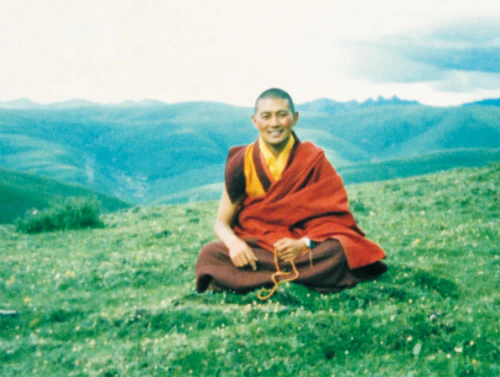
All the esoteric Dharma teachings above are “the essence of the enlightened intent of the vidyādhara gurus of the three transmissions, the lifeblood of one hundred thousand ḍākinīs, and the vital soul-jewel of ten million oath-bound Dharma protectors.” The Rinpoches most solemnly transmitted their most cherished muni jewels to Hor shul Khenpo Gelek Palsang Rinpoche. The blessing of the wisdom of the lineage’s enlightened intent neither increased nor diminished, just as one butter lamp lights another. While studying with Venerable Khenpo Qiaq, Hor shul Khenpo Gelek Palsang Rinpoche was extremely diligent. He even used mealtimes, reading scriptures while kneading tsampa. He studied a vast body of scriptures and treatises from all the major traditions, never allowing himself to become lax, and cherished the precepts of discipline—the fundamental jewel of every quality—as he cherished his own eyes. During his period of practice, for seven years he never lay down to sleep and never loosened his belt. He practiced sitting upright through the night for seven years. Many elderly people who saw this were deeply worried and said that if he continued, he would surely go mad. During those years, Hor shul Khenpo Gelek Palsang Rinpoche read every day, often until three in the morning. He rested only during the dozen or so days of annual grassland festivities; otherwise he had no holidays, and his body essentially never touched a bed.
While studying the Abhidharmakośa, Khenpo Qiaq personally debated with him. Hor shul Khenpo Gelek Palsang Rinpoche displayed extraordinary intelligence and eloquence and received the guru’s highest praise. The guru said, “Larung’s Khenpo Gubi—the learned one—is Khenpo Tsultrim Lodrö; our Lido Buddhist Institute’s Khenpo Gubi is you.” Because the guru praised him through most of every year, some vajra companions joked, “The guru often criticizes us but always praises you. Perhaps it is because you are handsome.” When Khenpo Qiaq later heard about this, he rebuked them before the assembly, saying, “I often praise him not because he is handsome, but because he truly possesses extraordinary intelligence, outstanding qualities and character, and exceptional diligence in study, reflection, and practice. His character is as steady as pure gold.”
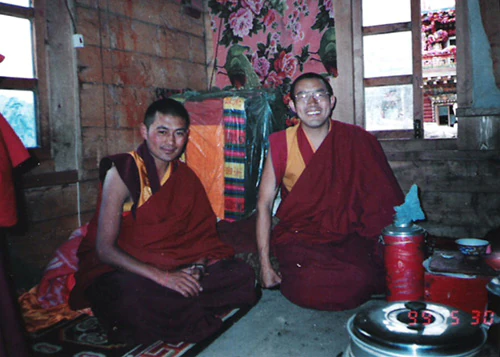
At the age of twenty, Hor shul Khenpo Gelek Palsang Rinpoche received full bhikṣu ordination before a complete assembly of bhikṣus at the Hor shul Institute of Sūtra and Tantra. He presented offerings of gratitude before the Khenpos and ordaining masters, pleasing them. From then on he was extremely rigorous in properly adopting and avoiding even the most minute allowances and prohibitions of the discipline, guarding the vows with extraordinary care like Mount Meru adorned with a garland of golden mountains.
At the age of twenty-four, Hor shul Khenpo Gelek Palsang Rinpoche passed successive strict examinations before the supreme protector and guru Qiaq Rinpoche and the monastic community, receiving the degree of Khenpo. The guru gave Hor shul Khenpo Gelek Palsang Rinpoche a Khenpo’s hat and related articles, invited him to ascend the Dharma seat of a Tripiṭaka Khenpo diligent in discipline, and announced that after he finished teaching each day, Hor shul Khenpo Gelek Palsang Rinpoche would give the supplementary explanation and guidance. When Khenpo Shirao later returned from the Musang region, Khenpo Qiaq instructed him to attend Hor shul Khenpo Gelek Palsang Rinpoche’s classes, saying that Hor shul Khenpo Gelek Palsang Rinpoche’s wisdom was now extraordinary and his Dharma explanations exceptionally incisive. From then on, Hor shul Khenpo Gelek Palsang Rinpoche began explaining the scriptures and teaching the Dharma, entering upon the work of propagating the Buddhadharma. Hor shul Khenpo Gelek Palsang Rinpoche also taught the Seven Treasuries as an assistant teacher. After Khenpo Qiaq completed his principal teaching of the Seven Treasuries, Hor shul Khenpo Gelek Palsang Rinpoche gave the supplementary teaching. As an assistant teacher, Hor shul Khenpo Gelek Palsang Rinpoche had to teach every day and read many books. Every day he read until after three in the morning. This was the course of his studies. Venerable Khenpo Qiaq was very fond of him and praised him every day in class. Venerable Khenpo Qiaq said, “A practitioner like Hor shul Khenpo Gelek Palsang Rinpoche is exceedingly rare in the world today.”
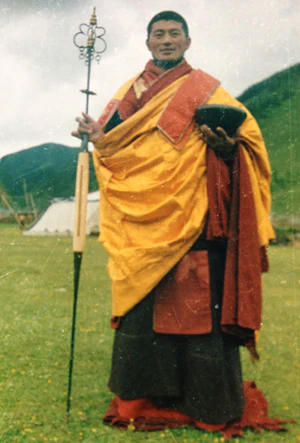
Hor shul Khenpo Gelek Palsang Rinpoche felt embarrassed and said to Venerable Khenpo Qiaq, “From tomorrow onward, please do not praise me, Guru. It is so embarrassing.” Venerable Khenpo Qiaq replied, “It is all right, it is all right!” The next day, Venerable Khenpo Qiaq praised Hor shul Khenpo Gelek Palsang Rinpoche in class again.
During his studies, Hor shul Khenpo Gelek Palsang Rinpoche often ate and attended feast offerings with Venerable Khenpo Qiaq, and he could go to Khenpo Qiaq whenever he wished.
What Hor shul Khenpo Gelek Palsang Rinpoche was most proud of was that, among all the gurus upon whom he had relied, he had never done anything that displeased them. Qiaq Rinpoche in particular manifested differently from other eminent monastics and great masters. It was well known that the elder had criticized and scolded many people, yet throughout the many years that Hor shul Khenpo Gelek Palsang Rinpoche relied upon him, Hor shul Khenpo Gelek Palsang Rinpoche never received even a minor rebuke. He treated every guru with the utmost respect and carefully followed their instructions. Toward Khenpo Qiaq he had faith inseparable from his faith in Samantabhadra Buddha. In ordinary times and during grassland festivals, he would often circumambulate and prostrate to the guru’s house. Many Dharma companions teased him, saying, “You see the guru every day; why be so attached?” He replied, “I am an ordinary person and must continually ask the noble guru for blessings.”
Just as the saying goes, “When certainty in the meaning of the Dharma has been gained, one hundred thousand Dharma treasuries well forth within the mind,” Hor shul Khenpo Gelek Palsang Rinpoche needed only to hear or read briefly the scriptures and tantras of sūtra and tantra and their commentaries, including the texts of the five great treatises, to understand them intuitively. He needed only to receive a lineage briefly before the supreme protector and guru to comprehend it without obstruction and teach it. His teachings followed the procedure by which arhats taught according to the three purities. Whether teaching the Dharma or composing a treatise, he was free from such faults as inappropriate wording, errors or flaws in sentences, and repeated recitation. His Dharma teaching was concise, lucid, and easy to understand; his explanations were pure, made the profound accessible, and were easy to realize. Hor shul Khenpo Gelek Palsang Rinpoche received the enlightened intent of the lineage gurus, spontaneously integrated it, and gained mastery of speech. This may be said to be a sign that all knots in the throat channel wheel had self-liberated. When the supreme hierarch of the Nyingmapa, Penor Rinpoche, returned to China in 1992, he came to Hor shul in Sertar, praised Hor shul Khenpo Gelek Palsang Rinpoche in the presence of Qiaq Rinpoche, and made many prophecies concerning the Khenpo’s future activities.
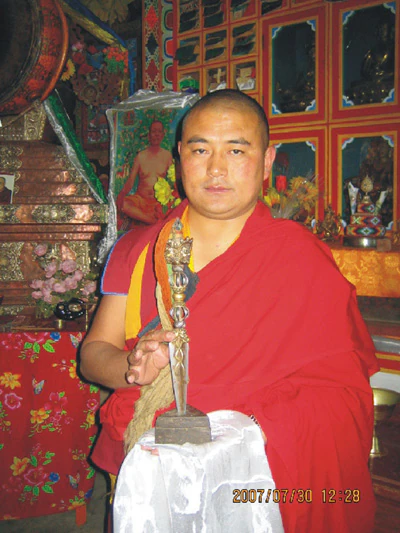
For one period, Hor shul Khenpo Gelek Palsang Rinpoche often spoke to himself and repeated whatever others said. Many other inconceivable things occurred, making those around him feel that he had become mad. The guru said there was no need to worry: he was continually abiding in the highest state of Dzogchen, the exhaustion of phenomena, thereby confirming that Hor shul Khenpo Gelek Palsang Rinpoche had attained ultimate realization of Dzogchen.
All spiritual friends who practice the conduct of bodhisattvas and uphold the precious Buddhadharma study the three progressively higher disciplines and bind their mindstreams with discipline. Master Vasubandhu said: “Possessing discipline, study, and reflection, join them well with meditative cultivation.” The sequence taught here is first to receive well the precious training in discipline and thereafter, in a single progression, to reach the far shore of the ocean of learning.
In general, Hor shul Khenpo Gelek Palsang Rinpoche’s conduct and behavior from childhood onward manifested the purity and cleanliness of his nature. As Bodhisattva Śāntideva said:
Wishing to destroy all the sufferings of saṃsāra, wishing to dispel the unhappiness of beings; though wishing to bring a hundred forms of happiness, never relinquish bodhicitta.
This present degenerate and turbid age is an evil time in which people high and low alike slight the genuine Dharma. Many practitioners discard the burden of the Buddhadharma while tightly clutching within their hearts the trifling reputation, gain, and possessions of the world.
There are also timid, foolish people with many discursive thoughts who seek many teachings every day and receive numerous empowerments, yet never recite scriptures or practice. Most Buddhists reject any Dharma that is even slightly difficult. They do not wish to present the gifts with which teachings are requested or make commitments to practice afterward. Instead they obtain teachings as casually as scooping water from a great river, as though requesting and hearing Dharma were acts of compassion toward the guru or ways of preserving the guru’s dignity. Hor shul Khenpo Gelek Palsang Rinpoche, by contrast, relied properly upon gurus from childhood. Although he had no abundant wealth, he did his utmost to present every lama—every guru—from whom he sought Dharma with pure, fine Dharma offerings. Before the genuine Dharma and instructions were complete within his mind, even when he lacked the necessities of life, he disregarded prolonged exhaustion and listened to the Buddhadharma. Later, when unexpected wealth appeared effortlessly and spontaneously, he presented a maṇḍala offering and pure material offerings every day. During empowerments and Dharma transmissions, Hor shul Khenpo Gelek Palsang Rinpoche always offered abundant and excellent gifts associated with recitation services and Dharma rites. In short, whatever the venerable one did, he took only conduct conforming to the scriptures and tantras as his standard. As the Treasury says:
The guru free of faults and complete in qualities,
In a defiled age is equal to the actual Buddha;
Serve purely, with reverence, and place him upon the crown of your head.
Thus he properly relied upon the Vajradharas endowed with the three vows. The Kṣitigarbha Sūtra also says:
With single-minded devotion and respect, listen to the Dharma; do not disparage or slander the Dharma.
One should also make offerings to the teacher of Dharma and give rise to the thought of seeing that person as the actual Buddha.
He showed such respect toward every spiritual friend.
The Ornament of the Ghanavyūha Sūtra says:
Mañjuśrī! Wherever there is a teacher of Dharma, the karmic obscurations of deeds of immediate retribution will be purified for anyone who sees that teacher. One should also make offerings to the Dharma teacher. Even if the Dharma teacher commits the five deeds of immediate retribution, do not let your mind become disturbed toward that person.
Hor shul Khenpo Gelek Palsang Rinpoche engraved the meaning of these words within his heart. He showed added respect even toward those who appeared to be ordinary people and listened fully even to a single instruction. He never slighted any Dharma he heard, but recorded it all in notebooks.
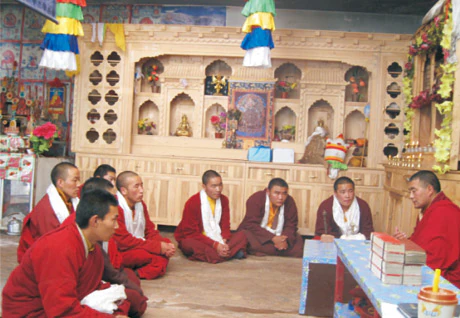
In addition, Hor shul Khenpo Gelek Palsang Rinpoche drew small illustrations of maṇḍalas, tormas, and other elements from both new and old tantras and acquired the materials for empowerments and offerings, never begrudging the expense. Hor shul Khenpo Gelek Palsang Rinpoche took as his sole great undertaking the pleasing of exceptional gurus and the benefiting of the Buddhadharma. As a result, the qualities of the paths and bhūmis that appeared in him reached perfection, while temporary auspiciousness and prosperity arose incidentally, like chaff accompanying a plentiful harvest, and all increased year by year. As the Ocean of Wisdom says:
Among all the deeds of one’s guru, every fortunate wise person
May constantly prostrate to the buddhas of the three times for six hundred thousand kalpas;
Yet greater than this is to carry out the guru’s instructions in accordance with the Dharma.
Every wish will be accomplished and immeasurable merit obtained.
Whoever pleases the guru with personal wealth and provisions,
Through this, amid the three realms of saṃsāra, will find solace in an emanation pure land
And ascend to the ground of nirvāṇa beyond sorrow.
Everything described here became manifest in the Khenpo himself.
With regard to every Dharma teaching he heard, the Khenpo did not stop at its name. He clearly understood—without mixing them—the distinctions taught by the various traditions, their views and methods of practice, the boundaries they established, their generation and completion stages, their individual profound points, the fine details of their liturgies and pith instructions, and the contents of their practices, all according to the conventions of each tradition. He then put them into practice and trained in them. As it is said:
A realized person should not make many promises; yet if, because of a difficult circumstance, he does promise,
It is like a design carved upon stone: even at death he will not change it into something else.
It is also said:
A fool draws a design upon water; as soon as it is drawn, it swiftly disappears without a trace.
A wise person is like a line carved in stone: though extremely fine, it remains firmly.
Most importantly, he practiced continuously the profound generation and completion stages of Secret Mantra. The details were as follows:
Within the New Translation schools, he undertook the recitation and practice of the yogic stages of the major and minor tantras, principally the Kālacakra; ḍākinī practices such as The Ḍākinī; protector practices such as Black-Cloaked and Four-Faced; and many other sādhana practices.
Within the Old Translation schools, he undertook the recitation and practice of the new and old treasures of Heart Practice of the Lotus-Born Guru: Greater and Lesser Peaceful and Wrathful Deities; the Dharma cycles of Great Compassionate Avalokiteśvara; the Great Gathering of Accumulations and the Peaceful and Wrathful Deities of the Magical Net; some nineteen systems of the Eight Herukas and the corresponding systems of Vajrakīlaya; new and old Longevity Practices; and individual teachings from the One Hundred Dharmas. He frequently performed feast offerings, fulfillment practices, and confession. On the two tenth days—the tenth and twenty-fifth days of each month—and on major festival days, he held abundant feast offerings. He often presented offerings centered upon garlands of butter lamps, neatly arranged and numerous, and conducted the successive Dharma activities of gathering accumulations, purifying obscurations, and increasing merit to an extent beyond the measure grasped by ordinary minds.
The Sūtra That Definitively Indicates True Faith says:
Śāriputra! The merit of whoever listens for an entire kalpa is inconceivable; yet the merit of resting in meditation upon reality—emptiness—for the snap of a finger surpasses it. Śāriputra! Therefore one should instruct others in meditation upon reality.
Likewise, the Mahāyānasūtrālaṃkāra (Ornament of the Mahāyāna Sūtras) says:
For those possessing yogic meditation, it is not meaningless; none of the Tathāgata’s teachings is meaningless.
Merely hearing and seeing without meditating upon the meaning will be pointless; practicing without having heard the teaching will bring no benefit.
In general, because of his innate strength, the Khenpo could accomplish the yoga of the channels, winds, and essences with characteristics without great exertion. Merely by relying upon a few outer conditions, the ten signs by day and night and the empty forms of the three realms arose; various sensations associated with luminosity, body, and essences—the gateways of arising—could appear; and he could directly see Dharma conduct without error. He therefore did not need to rely upon the path of gradual practitioners who hold or observe the arising, abiding, and ceasing of mind in successive stages, but entered the womb of view and meditation in which self-nature is spontaneously complete and the essential nature rests in vastness.
Within the Nyingma tradition, the Khenpo chiefly practiced the three systems of the Mind Section; the Space Section’s aural lineage of the Vajra Bridge; the Vima Heart Essence; and the Ḍākinī Heart Essence. Among treasure teachings, he practiced the profound guidance teachings principally of the Longchen Nyingthig, the guidance teachings of the Tropu tradition such as Practice of the Nature of Mind, and the guidance teachings of the Poto tradition such as The Seven-Day Essential Dharma. In short, among all the guidance teachings the Khenpo had ever heard, there was not one upon which he had not meditated. The qualities of the venerable one’s meditative experience and realization therefore increased day by day.
The Prajñāpāramitā in Eight Thousand Lines says:
A bodhisattva fully embraced by a spiritual friend will attain unsurpassed, pure, perfect awakening and become a buddha.
The Noble Summary in Verse also says:
For the Buddhadharma one should rely upon a spiritual friend; the Buddha declared this the most excellent of qualities.
From childhood, the sole object of this noble person’s delight and aspiration was to rely upon impartial spiritual friends and gurus and seek the exceptional genuine Dharma from them. This was the principal deed of the venerable one’s great undertaking.
In today’s Buddhist community, those who are proud because they possess noble family, exalted rank and power, or conspicuous wealth are unwilling to rely upon lamas—gurus—lower than themselves, even when those lamas possess the qualities of Dharma. They worry about preserving their own status or being criticized by others, or they are driven by the prideful thought of “who I am.” Those with a little knowledge of the sutric and tantric scriptures also grow proud of their slight and partial understanding, think themselves learned or great geshes—spiritual friends—and inflate their inner pride, showing respect to no one. Some people think, “I belong to this monastery” or “I inherit this Dharma tradition,” and cling to only one side. Some blindly cling to a guru of their own tradition regardless of whether the guru possesses qualities. Others know only how to gather offerings made in faith while pursuing petty methods of finding food and subsistence. Apart from these, those who seek profound and vast teachings are exceedingly rare.
Within the vast darkness of this turbid age, the Khenpo was entirely free of pride in family, bloodline, status, power, wealth, or anything else. No matter how much learning, wisdom, and virtue he possessed, he never showed even the slightest pride. Yet he praised each small quality in others as something rare.
The Khenpo was entirely free of partiality arising from attachment to his own tradition. He showed equal respect to all masters who upheld Buddhism in the Land of Snows. He repeatedly studied and reflected upon the distinct Dharma streams of every tradition and the teachings whose sources were established, penetrating them completely and deeply. He remained forever diligent, without the slightest weariness.
The Buddhist scriptures praise the qualities of great learning extensively. As the Bodhisattva Piṭaka says:
Through hearing, one knows the meaning of all phenomena; through hearing, one can dispel all wrongdoing.
Through hearing, one can sever everything unbeneficial; through hearing, one can attain nirvāṇa.
Maitreya, the future buddha, expressed in verse the meaning that the Buddha explained in fine detail in the scriptures:
Without mastering the five fields of knowledge, even a buddha cannot become omniscient.
Therefore, to overcome and gather others, strive in study to become all-knowing. Sakya Paṇḍita said:
If one’s own mind does not study the fields of knowledge, complete knowledge lies farther away than the edge of space.
With this enlightened intent, the buddhas and their heirs declare in one voice that one should study the fields of knowledge.
First, study and reflect upon the fields of knowledge.
The circumstances were as follows:
The Khenpo studied the text called Shāwen on the Sarasvatī Grammar, based upon a commentary by a Kathok Paṇḍita. He memorized it and passed the recitation examination perfectly, all within only one month.
The Khenpo particularly enjoyed logic. He studied The Support of Collected Topics, explanations of the Commentary on Valid Cognition based upon Venerable Gyeltsab’s interpretation, and other works, and received the explanatory lineage of the abbreviated meaning combining the Sūtra on Logic and the Commentary on Valid Cognition.
In the field of arts and crafts, although the Khenpo had no opportunity for hands-on practice, he knew the texts describing the dimensions, postures, and other features of supports for the Buddha’s body, speech, and mind—Buddha images, Buddhist scriptures, and the Buddha—more thoroughly than others.