The Path of Compassion: A Biography of Hor shul Khenpo Gelek Palsang Rinpoche
The Path of Compassion: A Biography of Hor shul Khenpo Gelek Palsang Rinpoche — Part Two: Hor shul Khenpo Gelek Palsang Rinpoche — Chapter Five: Exceptional Service and Vast Offerings
The deeds of service and offering that the Khenpo performed toward the supreme fields of his teachers, the saṅgha, and others are described below.
Before receiving the nectar of profound and vast Dharma from each of his teachers, vajra-holders, and spiritual friends in succession, he would present a gift requesting the teachings—a flower or a maṇḍala offering. After completing his request for Dharma, he would again bring forth with all his strength clouds of material offerings to repay their kindness. Untainted by the slightest stain of pretense or miserliness, he joyfully made such offerings many times with great reverence and purity. For Dharma activities and other purposes, he repeatedly gave exquisite and pure material objects, principally supports of enlightened body, speech, and mind, as well as necessities for use and enjoyment. In this and other ways, he extensively served and made offerings without partiality to his teachers and to those with whom he had Dharma connections. As the Fifty Verses of Guru Devotion says:
Whatever they desire, even things difficult to bear, every slight and pleasing thing; one's own most excellent possessions—offer all of these to the teacher.
Every extensive method of serving and making offerings to spiritual friends taught in all the sūtras, tantras, and treatises was engraved in the venerable master's heart, and he put each one fully into practice.
Most large and small monastic communities, regardless of tradition, had declined severely because of the confused and turbulent circumstances of the present time. The Khenpo therefore donated many articles and provided repairs, mediated relations among monasteries, taught what conduct to adopt and avoid, and untied points of contention. In this way he became an enhancing condition through which Buddhism and the monasteries could be restored to their original state and return to peace. He donated funds for offerings to the buddhas and arranged matters properly, in accordance with the Dharma and the established rules, thereby enabling Buddhism to flourish and vast merit to increase. As the Jātaka says:
The moon delights in celebration, the sun shines most brightly, fire blazes, and the wind moves swiftly;
great beings rejoice in compassionate hearts—their nature of benefiting others is innate.
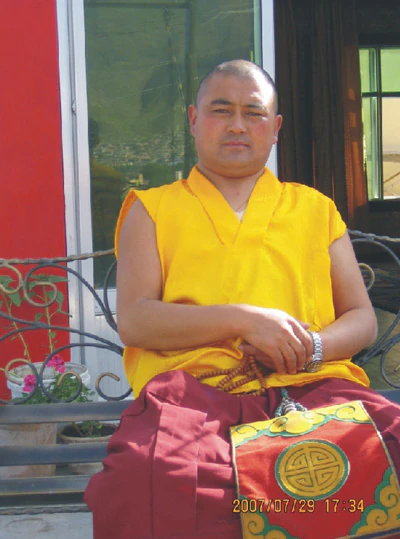
To take teaching the Dharma and benefiting beings as his sole responsibility—this seems a true portrait of the Khenpo. In addition, each year he gave large and small monasteries with which he had connections donations for reciting dhāraṇīs and dedication prayers. He also protected recluses dwelling in virtuous conduct in remote mountains by providing the authentic Dharma and favorable conditions in the form of pure provisions for sustenance.
Nor was there ever an interruption in the consecutive practice sessions he held or the clouds of offerings he regularly made.
Festival offerings—especially each abundant offering on the tenth days of the waxing and waning moon—included garlands of hundreds of butter lamps and clouds of feast offerings, made as plentiful as possible.
On the four great Buddhist festivals and on the full-moon, new-moon, and eighth days of the month, he arranged abundant incense and garlands of hundreds of butter lamps in conjunction with recitation and ritual practice. As taught in the Samantabhadra Aspiration Prayer, year after year without interruption he presented vast clouds of offerings as adornments. He devoted himself especially and diligently to methods of gathering the accumulation of merit. The Khenpo's diligence in these virtuous deeds must have arisen from faith in profound karmic causality and interdependence, not from others' preaching. Thus deeds of this kind could not fail to amaze the wise. As the verse says:
The signal of generosity calls well; speaking loving words guides the mind;
beneficial conduct gathers and consoles people's hearts; cooperation gathers them for shared deliberation.
Through the firm force of the Khenpo's habituation over kalpas to the four means of gathering disciples—the methods for guiding those to be taught—he had gained command of the bodhisattvas' exceptional activities of this kind. To people of every rank, high or low, he gave abundant material gifts without scarcity, causing delight and joy to arise in them.
To the broad range of poor, deprived, and lowly beings, including birds and dogs, he gave plentiful food, clothing, and other necessities, benefiting their bodies and minds. He even gave them pleasing words and joyful conversation, bringing happiness to their minds.
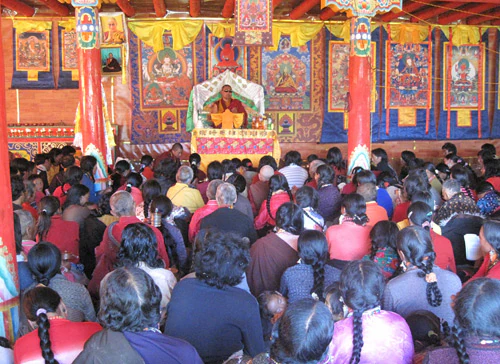
Because of objective conditions, women in Tibet had greater difficulty than men gaining an education, so many girls could not attend school and remained at home herding yaks. To give them opportunities to receive an education, study, and practice the Buddhadharma, to help resolve the sufferings of this life, and to free them from saṃsāra, Hor shul Khenpo Gelek Palsang Rinpoche built a dedicated “School for Young Women” in a remote region and invited well-trained teachers to teach there. Because Tibet's pastoral regions are immense and places where herding families can study and practice the Buddhadharma are inconveniently situated, the Khenpo built a large lay practitioners' assembly hall at the center of the pastoral region to make practice accessible. He built small assembly halls in many remote pastoral areas so herders could gather to study and practice the Buddhadharma. Since many elderly Tibetans could not read, the Khenpo paid each month to hire teachers who taught them recitation and literacy and guided them in daily practices for birth in the Blissful Pure Land, including phowa, Avalokiteśvara practice, and the Aspiration for the Blissful Pure Land. He also built two young-lama schools in Zamtang County, Master Mencuo's home region. One was at the monastery formerly associated with the Khenpo's grandfather; the other was built at Gongma Monastery with Lama Gezha, Master Mencuo's younger brother. Hor shul Khenpo Gelek Palsang Rinpoche covered all expenses for the young lamas. The Khenpo has now established five Dharma schools with approximately six hundred students, making an important contribution to Buddhist education. During his free periods each year, the Khenpo traveled to villages throughout Dokham, Ü-Tsang, and Amdo, teaching countless followers the authentic Dharma, including the Guide to the Blissful Pure Land, Vajrasattva, and Avalokiteśvara's Self-Liberation of Suffering, thereby opening wide the inexhaustible door of Dharma generosity. He vigorously urged local villagers to abandon illegal harmful acts and bad habits, including killing, tobacco and alcohol use, hunting, theft and robbery, destruction, fraud through false oaths, sexual misconduct, quarrels, fights, and mutual harm. He broadly counseled them to forsake wrongdoing and practice virtue by “banning fishing and hunting, refraining from theft, making pilgrimage to purify obscurations, ransoming lives, and releasing animals,” and taught followers to observe the ten virtuous precepts. Khenpo Rinpoche's counsel and guidance in promoting virtue and preventing wrongdoing immersed the region in an atmosphere of peace and friendliness and transformed it into a bright, pure land; his activities became as vast as space. Many disciples placed the dust of the Khenpo's feet upon the crowns of their heads as an offering, revered him as their root teacher, and served and honored him. The Khenpo, in turn, accorded with each person's capacity and bestowed suitable guidance in the pith instructions of the profound secret Dharma, carrying out great activities to protect and spread the Buddhadharma.
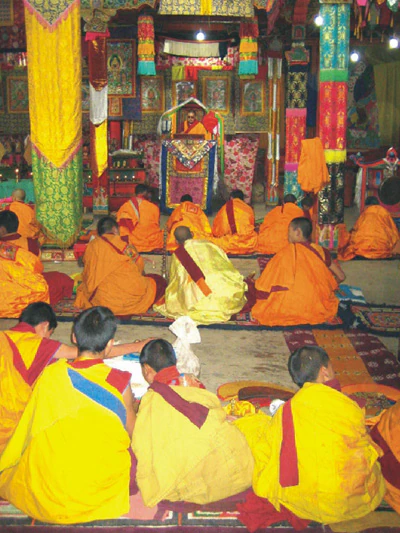
Xigong Mazhi Rinpoche personally said, “Hor shul Khenpo Gelek Palsang Rinpoche and I are now inseparable.” Qiaq Rinpoche likewise praised him many times before the assembly: “Hor shul Khenpo Gelek Palsang Rinpoche has a steady character. His future activities of teaching the Dharma and benefiting beings will reach their zenith and remain unchanging like pure gold.” There were many such praises. The Khenpo's writings and mind treasures from this life, including various profound secret-Dharma rituals, already filled about five traditional volumes. Because the time and conditions had not ripened, they had not yet been made public. Many masters prophesied that because of the great treasure revealer's habituation in a previous life, Hor shul Khenpo Gelek Palsang Rinpoche would reveal many treasures in this life—at least ten or more traditional volumes. Many earlier great treasure revealers also prophesied that anyone who formed a connection with Hor shul Khenpo Gelek Palsang Rinpoche, the Young Lama Buddhist Academy, or related activities would spontaneously fulfill every virtuous worldly wish and, upon death, take birth in the Blissful Pure Land and attain liberation. If the auspicious interdependence was not disrupted, he would guide beings as numerous as the sands of the Ganges—human, nonhuman, and others—to birth in the Blissful Pure Land in this very life. Since the Buddhist academy's founding, including during construction of the main assembly hall, not a single obstacle had occurred. As everyone could directly see, Hor shul Khenpo Gelek Palsang Rinpoche's activities advanced extremely rapidly. The Khenpo himself said this was not due to his virtue, but to the kindness and blessing of his two immensely kind teachers. Dharma King Jigme Phuntsok and Qiaq Rinpoche had personally told him many times that they would directly bless his future activities of teaching the Dharma and benefiting beings and the disciples of his lineage. There was not the slightest falsehood in this, so the Khenpo's disciples could also form an exceptional direct connection with the two root teachers.
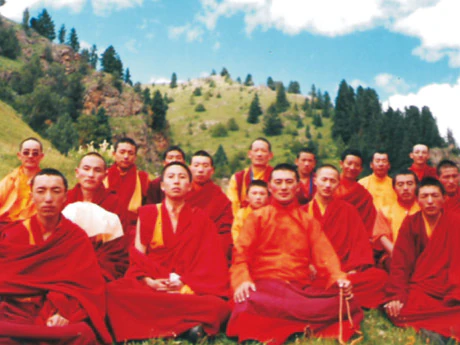
Hor shul Khenpo Gelek Palsang Rinpoche never interrupted his practice. He practiced only the primordial purity of awareness through the direct cutting of Trekchö in Dzogchen, applying it experientially and tracing it to the very source in order to verify it. Through this realization, he liberated himself and guided others with great compassion; he was a genuine yogin of definitive meaning who had mastery of mind and appearances. Of all offerings given in faith or for rites on behalf of the deceased that were presented to the Khenpo personally, he never touched so much as a needle or a length of thread, nor would he ever permit himself to do so. He was entirely content with simple food and rough clothing, never indulging freely in wealth for his own use. All his personal assets were offered without reservation as resources to support Buddhist education and the monastics' activities of teaching and practice. Hor shul Khenpo Gelek Palsang Rinpoche often said that he possessed not the slightest virtue or power of blessing, but he believed that his two root teachers were siddhas and that disciples would receive their direct blessing. Hor shul Khenpo Gelek Palsang Rinpoche always followed Khenpo Qiaq Rinpoche's instruction: “Hide your own virtues; proclaim the virtues of others.”
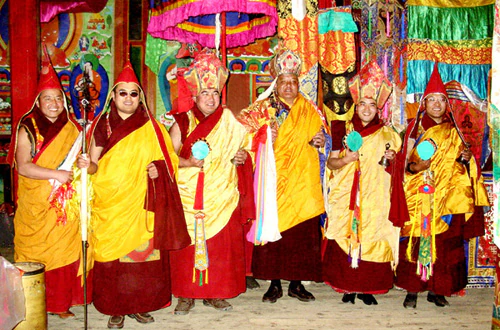
In short, Hor shul Khenpo Gelek Palsang Rinpoche was unquestionably a great upholder of the teachings and true successor to the supreme protector-teacher. As Lama Achuk Rinpoche said, “Hor shul Khenpo Gelek Palsang Rinpoche is a protector of the teachings and an auspicious refuge and protector of beings.” He upheld all sentient beings with inexhaustible kindness; even enough gold to fill the three-thousandfold great-thousand world could not repay such kindness. Because the virtues of the Khenpo's activities and those of the Buddhist academy were inconceivable, sentient beings who formed a connection with them could attain liberation even while wandering through the ocean of suffering of the six realms of saṃsāra. The above is a brief account of Hor shul Khenpo Gelek Palsang Rinpoche. Although many rare deeds were transmitted by word of mouth and many prophecies concerning the Khenpo could be cited from other canonical and treasure teachings, the Khenpo himself greatly disliked publicity and did not authorize extensive translation. Only prophecies by a little more than ten siddhas were translated. Such was this stainless intention, these true and natural words, and this exquisite sound that delights those with karmic connections and adorns the faith of those who wish to entrust themselves. By this virtue, may those who offer lamps of the teachings remain, their lotus feet steadfast for oceanic kalpas; may they spread Buddhism so that beings enjoy the fruit of auspicious benefit and happiness.
The Khenpo himself often said that he was an ordinary person with no virtuous biography to introduce. His only distinction was that he relied properly and in accordance with the Dharma on every teacher and never did anything before any teacher that made the teacher angry or unhappy, or even caused the teacher to cast him a sidelong glance. What delighted him most was that throughout his life he had never received even a minor rebuke from Qiaq Rinpoche; instead, Qiaq Rinpoche often praised him before the assembly. He always relied on every teacher through the three kinds of delight and never caused them weariness. This, he said, was the greatest virtue and biography.