The Path of Compassion: A Biography of Hor shul Khenpo Gelek Palsang Rinpoche
The Path of Compassion: A Biography of Hor shul Khenpo Gelek Palsang Rinpoche — Part Two: Hor shul Khenpo Gelek Palsang Rinpoche — Chapter Seven: Exceptional Deeds
Local people in Qinghai knew that Hor shul Khenpo Gelek Palsang Rinpoche had his own terma, the “Circular-Light Divination,” and made extensive offerings while requesting him to perform divinations for them. When someone local died, they otherwise had to travel to the distant Yachen Monastery in Pelyul County, Sichuan, to ask the great accomplished master Lama Achuk Rinpoche to conduct a divination and examine the matter; transportation was particularly inconvenient. Moreover, Hor shul Khenpo Gelek Palsang Rinpoche’s divinations could reveal the results in great detail. They therefore promised before the Khenpo that for every divination they received, they would release one sheep as the offering for it. The Khenpo could not bear to refuse, and as a result, long lines of people waited for divinations almost every day from morning until night. His readings of the destinations of the deceased were extremely accurate. Afterward, some people compared his findings with those of Lama Achuk Rinpoche, and they matched exactly. They all called the Khenpo a genuine great tulku.
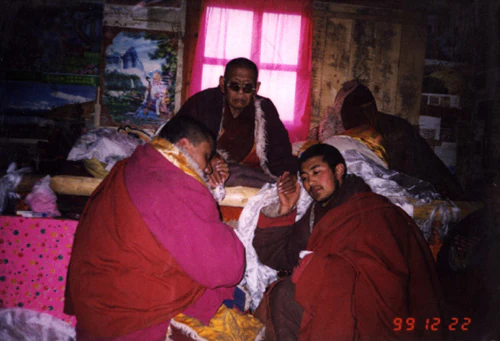
Hor shul Khenpo Gelek Palsang Rinpoche had many yogi disciples who possessed miraculous powers. Although they themselves had such abilities, they still asked the Khenpo to decide important matters. On one occasion, for example, many people said that an earthquake would strike Nangchen at midnight on a certain day, and many fled. Numerous great yogis could not decide what would happen and consulted the Khenpo. The Khenpo assured them that it absolutely would not occur and told everyone not to panic, thereby calming the people’s minds. One yogi had been extremely bad-tempered in his early years, and many people disliked him. Yet he alone had great faith in the Khenpo and said that even dying while working for his guru would be worthwhile. Although he had never undergone systematic study, reflection, and practice, through his own faith and the blessing of Hor shul Khenpo Gelek Palsang Rinpoche’s mind transmission, he suddenly developed great miraculous powers in recent years. Many places invited him to resolve difficult problems, and he is now respected by all. Once, for several consecutive days, the Khenpo dreamed of auspicious signs such as rainbows appearing east of Gongya Monastery. Thinking that something exceptional must be there, he personally led people in a search, pointed out a particular place, and had them excavate a large stone. On it was a very clear, self-arisen Manjushri heart mantra, as distinct as though carved with tools.
One autumn at Gongya Monastery, when it was time to harvest the crops, the sky was cloudless every night and frost struck morning after morning; when there are clouds at night, there will be no frost in the morning. Everyone therefore asked the monastics in the monastery’s retreat center to recite rituals for averting disasters for several days, but this had no effect. Seeing that the entire year’s harvest was about to be ruined, everyone became very anxious and collectively requested the Khenpo to perform a Dharma rite. At the time, he was teaching Tulku Oba’s Ornament of Clear Realization. The Khenpo was unfamiliar with agriculture and outwardly appeared uncertain. Preventing frost differs from preventing hail, since the latter can show an immediate result, whereas preventing frost is much more difficult. He only agreed to try. That night, the Khenpo dreamed of Tulku Oba and Guru Qiaq and asked them many difficult questions about the Ornament of Clear Realization.
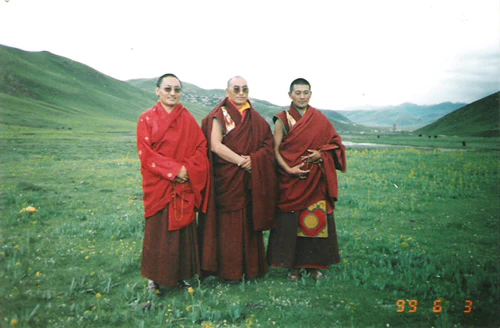
When the Khenpo arose in the morning, he recited the Ornament of Clear Realization once and did nothing else. He had someone drape his bhikshu’s outer robe over the ritual platform. The sky remained cloudless that evening, and some people began to doubt. At daybreak the next morning, however, the monastery steward saw that the entire robe had swelled up. When he approached, he found that it was full of frost underneath, enough to gather into a large sack. The Khenpo had it passed among the monastics. Everyone was astonished and developed intense faith. When they looked outside, there was not the slightest frost on the ground. No frost fell again until the harvest was complete. Unexpectedly, that year’s yield was eight times greater than in previous years, and local devotees developed uncontrived faith in the Khenpo as if he were a buddha. In the history of Yushu Prefecture, even many elderly people had never heard of such an inconceivable miracle in their lives. A great accomplished master in the region had once averted a frost disaster by turning a bowl upside down and gathering the frost into it through recitation. But no one had ever heard of a harvest increasing so greatly. The Khenpo told everyone that it was not his own ability, but the blessing of the gurus.
Many disciples in Qinghai had immense faith in Khenpo Rinpoche. Many vowed to recite one hundred million heart mantras and release ten yaks in order to receive one bead from the Khenpo’s mala, which he had used for extensive mantra recitation; people who wore such beads were said to have escaped many calamities. A blind elderly man came seeking a blessing. The Khenpo blessed him and instructed him to recite the Avalokiteshvara heart mantra one hundred million times; three years later, the man regained his sight. A cancer patient soon recovered after drinking water blessed by the Khenpo. Someone with an incurable illness was given a piece of cloth from clothing the Khenpo had worn and instructed to burn it to ash and swallow it; the illness gradually improved. One person had become insane after being possessed. Many great masters were invited to recite and bless him, but he did not improve. The Khenpo was then invited to recite for him and perform the practice of Chöd, and he soon returned to normal. Another place had endured a prolonged drought. Local disciples collectively requested the Khenpo’s blessing, and soon heavy rain fell, ending the drought. Exceptional instances of this kind were too numerous to count. Before dying, many people instructed their relatives that after their death, the first person they must invite to recite and guide them was Hor shul Khenpo Gelek Palsang Rinpoche. Some people from distant places even transported the deceased to Hor shul in Sertar so that the Khenpo could personally guide them, demonstrating the devotees’ faith.
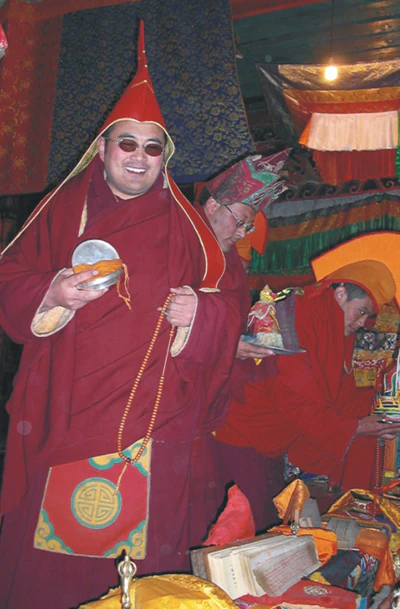
In Hor shul there was an old man named Könchok. In his youth, he had killed many beings and committed numerous negative deeds. He was publicly regarded as the least intelligent person in all of Hor shul, and his old age was very pitiable. When he was over seventy, Hor shul Khenpo Gelek Palsang Rinpoche told him to put on monastic robes and ordain. He was illiterate, knew no Dharma practice, and was very dull, so the Khenpo taught him only phowa. Although he was slow-witted, he had great faith in the Khenpo. He said, “I have never seen Amitabha Buddha and do not know how to visualize him, but it is enough for me simply to think of Hor shul Khenpo Gelek Palsang Rinpoche, because I can often see him.” After returning home and practicing for three days, the crown of his head opened. While he slept, much pus, blood, and other fluid flowed from his head onto his pillow. His body was extremely hot at the time, and he remained in bed for two days. When the pus and blood had dried, his head stuck to the pillow, and he came to see Hor shul Khenpo Gelek Palsang Rinpoche with it attached. Many people laughed when they saw him. He asked Hor shul Khenpo Gelek Palsang Rinpoche what this meant and whether it was bad. The Khenpo said that it was very good and told him, “Do not forget me. Keep practicing in this way.” After returning home, he was ill and bedridden for three months. He visualized only Hor shul Khenpo Gelek Palsang Rinpoche and did a little practice resembling phowa. As death approached, he said that his home was a very beautiful palace. His family thought that he must be confused because he was dying, for in fact the house was extremely poor. His son wanted to dress him in new lay clothes, but he refused, saying, “I am ordained and will wear only monastic robes. Invite Hor shul Khenpo Gelek Palsang Rinpoche at once to guide me.” After the Khenpo arrived, he bestowed the Amitabha empowerment. As soon as the transmission was complete, the man passed away. A large patch of hair fell from the crown of his head, and many auspicious signs appeared, witnessed directly by many people. Hor shul Khenpo Gelek Palsang Rinpoche joked with those around him, “If another great tulku were to say that he has fallen into hell, I would no longer have the slightest faith in them. I am one hundred percent certain that he has gone to Sukhavati.” Afterward, the family personally went to Yachen Monastery to ask Lama Achuk Rinpoche about the deceased. After examining the matter, Lama Rinpoche said that no further Dharma rites were needed: through the help and blessing of a great accomplished master, the man was already in Sukhavati. When local people learned this, they found it extraordinary that such a dull person, burdened by grave negative deeds, could be blessed into rebirth there, and they regarded Hor shul Khenpo Gelek Palsang Rinpoche’s power of blessing as inconceivable. In Qinghai, many people who were bedridden before death would continually press their palms together. Their families found this strange and asked why. They replied, “Hor shul Khenpo Gelek Palsang Rinpoche has personally come before me to bless me. Can’t you see him?”
There was a great ḍākinī renowned for her miraculous powers and for the accuracy of her divinations. When people came to consult her, she told them, “If you need recitations and Dharma rites, go to Hor shul and find Hor shul Khenpo Gelek Palsang Rinpoche. Have the young monks of the Hor shul Young Monks Buddhist Institute perform the rites. Their blessing is powerful and resolves problems very quickly, because among those young monks are many reborn great accomplished masters, and the saṅgha’s discipline is pure and their practice is excellent.” At one time, a great obstacle arose in an area near Sertar. People invoked a Dharma protector through an oracle and asked what to do. Speaking through the oracle, the protector said that only Hor shul Khenpo Gelek Palsang Rinpoche could avert this obstacle, because he possessed a special karmic connection and ability. The Khenpo later came in person, recited, and performed subjugation, averting the great local obstacle. To this day, many Tibetan and Han Chinese devotees seek out Hor shul Khenpo Gelek Palsang Rinpoche and the institute for divinations and Dharma rites. After the Khenpo once taught in a certain place, a disciple found relics and unidentified jewels in the room. In several disciples’ homes, a strong fragrance associated with pure discipline lingered for a long time after he had stayed for a few days and departed. On many occasions, while he was traveling elsewhere, distant disciples directly saw Hor shul Khenpo Gelek Palsang Rinpoche come to bless and guide them before death.
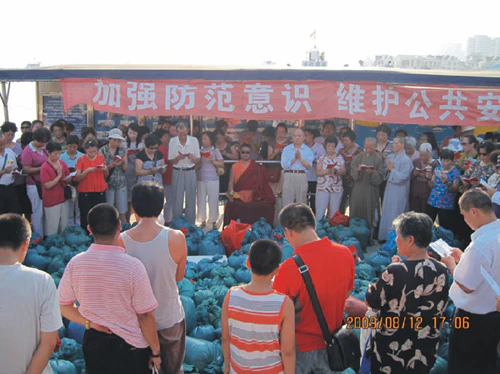
One year, on the return journey to Qinghai, someone with sectarian prejudice performed a fierce rite of destruction against the Khenpo’s party. Their vehicle reached a steep cliff where heavy snow was falling. Local people called the place “the Gate of Death,” because dozens of accidents occurred there every year, and no one whose vehicle plunged over the cliff had ever survived. A great master had observed that an extremely formidable demon king inhabited the place. Many people had been invited to perform rites, but perhaps because the conditions were incomplete, their efforts had never worked, and accidents continued. The Khenpo, his attendants, and their vehicle then plunged from the high cliff, and the vehicle was smashed to pieces. The Khenpo immediately rested in his realization without the slightest disturbance. He directly beheld Guru Padmasambhava, several stories tall and wearing a black cloak; his face and every detail of his clothing were clearly visible as he bestowed his blessing. The Khenpo remained in awareness without the slightest panic. He was neither injured nor unconscious. Everyone else lost consciousness, and one person was thrown out of the vehicle.
They all thought that it was over, but the Khenpo said that everything was all right and no one would die. When they later found the person thrown from the vehicle, he was indeed unharmed. It was truly miraculous: through the Khenpo’s blessing, not one person was injured. After they left the place, there was no snow anywhere around them, showing how formidable the demon king was. No further vehicle accidents ever occurred there. Through the Khenpo’s special blessing, the demon king was subdued and the adverse condition transformed into a favorable one. The Khenpo bore no resentment but embraced his practice with great compassion. When many people heard what had happened, their faith in him grew stronger. Khenpo Qiurang of Hor shul Monastery also knew the event clearly, because one of his attendants had been present. The following spring, the Khenpo deliberately arranged for Hor shul Monastery to hold an assembly devoted to averting the area’s obstacles. Not long afterward, an epidemic spread locally and a series of inauspicious events occurred, but the harm was slight, which people found inconceivable. When the Khenpo later spoke of the matter, it became clear that he had long before perceived in luminous meditative absorption that a great disaster would occur and had arranged the assembly in advance. Monastics who had initially half-believed his words then developed tremendous faith in him.
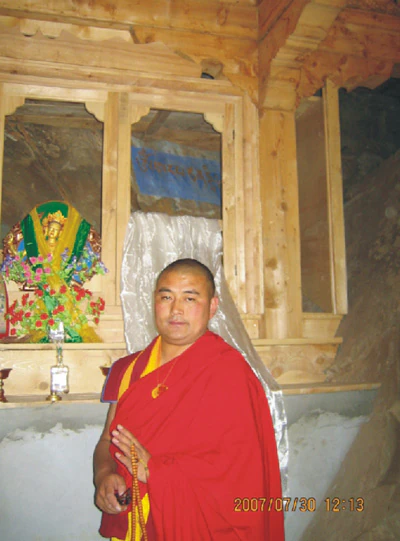
When Hor shul Khenpo Gelek Palsang Rinpoche taught in various places, many people directly saw nāga kings and nonhuman beings come for refuge. Some disciples saw Hor shul Khenpo Gelek Palsang Rinpoche appear in different forms while he taught, such as Amitabha Buddha, Avalokiteshvara, and Guru Rinpoche. Once, several yaks the Khenpo had bought for life release and entrusted to his family were stolen. A long time passed before he learned of it. He said that there was no problem and that the matter could simply be entrusted to the Dharma protectors, and he performed no rite at all. Before long, the yaks returned on their own. Everyone found this strange, and the story gradually came to light. The thieves had hired a large truck whose driver knew nothing of the theft, intending to sell the yaks to a slaughterhouse in Barkham. When they were ten kilometers outside Barkham, they suddenly heard the yaks speaking from the back: “Take us home.” All of them were terrified. The driver refused to go any farther, thinking that something must be wrong, and the thieves also became frightened. They had no choice but to return the yaks secretly. The driver spread the story. People said that they had never in their lives heard of yaks speaking human language and that the Khenpo’s Dharma protector was extraordinarily powerful.
When many of the Khenpo’s disciples encountered obstacles in practice or needed to resolve worldly affairs, they recited the Prayer for Hor shul Khenpo Gelek Palsang Rinpoche’s Long Life, composed by Lama Achuk Rinpoche, and prayed; their problems were invariably resolved, whether they involved obstacles to practice, family happiness, the development of wisdom, severe illness, or difficulties in their activities. At the same time, multiple people in different places received telephone calls from the Khenpo. He knew what others were thinking and sometimes pointed out matters so secret that no one else knew them.
In the previous two years, many people in Hor shul had fallen ill, and several young people had died. Many were afraid and preparing to leave. When they asked the Khenpo, he examined the situation and said, “Do not worry. Once I have erected the statue of Thangtong Gyalpo here, the problem will certainly be resolved immediately.” And so it was: as soon as the statue was installed, the obstacle subsided. The Khenpo told certain karmically connected disciples about their previous lives, and his accounts coincided with the observations of other great tulkus.
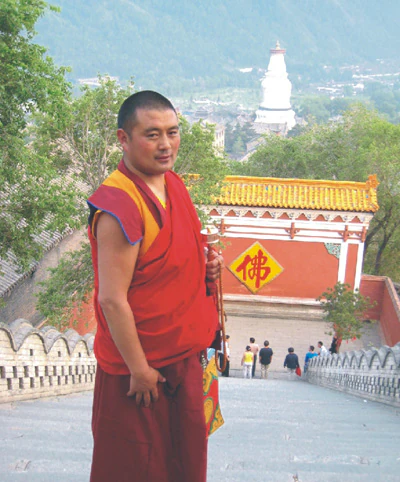
Exceptional Anecdotes
One. When the Hor shul Young Monks Buddhist Institute erected a statue of Thangtong Gyalpo and Hor shul Khenpo Gelek Palsang Rinpoche and the saṅgha consecrated it, Thangtong Gyalpo appeared in the form of a cloud, dissolved into the statue, and a rainbow appeared. Many people directly witnessed these auspicious signs.
Two. Hor shul Khenpo Gelek Palsang Rinpoche vowed to offer one hundred million lamps in this lifetime and had a lamp-offering house built especially for this purpose. The principal offering lamp there remained alight for a long time, burning several times longer than an ordinary lamp of the same kind. It was like the time of the Buddha, when a poor woman made a vast aspiration and offered a lamp that remained burning for a long time; even Venerable Maudgalyāyana could not extinguish it with his miraculous powers.
Three. During the bitterly cold Tibetan winter, when the temperature fell more than twenty degrees below zero, other offerings such as alcohol and water in the shrine hall of the Hor shul Young Monks Buddhist Institute froze solid. Yet milk offered before the principal image of Hayagrīva in the protector chapel did not freeze throughout the entire winter. This was an exceptional auspicious sign.
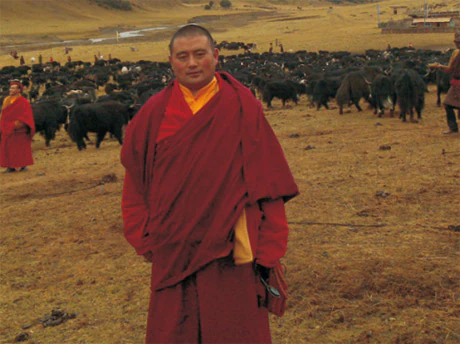
Four. When an infectious disease spread through a certain place and eighty percent of the people were infected, Hor shul Khenpo Gelek Palsang Rinpoche transmitted the practice of Black Hayagrīva to those affected, and their illnesses disappeared immediately.
Five. A large family in a certain place suffered interference from obstructing spirits, and a series of inauspicious events occurred: suicide, traffic accidents, dead yaks, severe illness, and acts of vengeance. The family asked a great yogi from Qinghai to come recite and bless their home. The nonhuman being involved was so powerful that it caused heavy snow to fall in summer, blocking the mountain and cutting off transportation so that the yogi could not go. He sent a message: “You should invite Hor shul Khenpo Gelek Palsang Rinpoche. It depends on your merit; if he is away, there is no point in looking for anyone else, because nothing can be done.” Hor shul Khenpo Gelek Palsang Rinpoche happened to be at home, so he went especially to recite the great reversal ritual of the special terma of Siṃhamukhā for three days. When their enemies came seeking revenge, they shot at family members three times in succession, but the bullets rebounded from their bodies to the ground and left them completely unharmed. The attackers thought that a divine being must be protecting them, felt remorse, and reconciled the feud. Later, when the family’s mother died, the Khenpo came to guide her and suddenly sensed that her destination was very unfavorable, because she had committed many grave negative deeds while alive. The family had wholesome roots and great faith in the Khenpo. When they asked where the deceased had gone, the Khenpo said, “I do not know where she has gone. Perform many Dharma rites, and then go to Yachen and ask Lama Achuk Rinpoche.” After completing the rites, they went to Yachen. Rinpoche said that the deceased had fallen directly into hell without passing through the intermediate state, but that because they had performed many Dharma rites and a great accomplished master had guided her, she had now been reborn as a human. He also gave the detailed address.
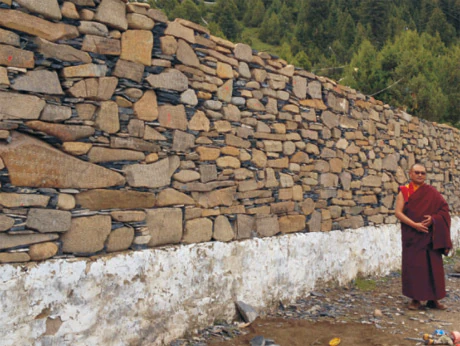
Six. The mani stones at Ala Sacred Mountain were all selected on distant high mountains. The chosen stones were of excellent quality, hard, and able to endure for a long time. Hor shul Khenpo Gelek Palsang Rinpoche invited the most skilled elderly artisans in Tibet to carve them meticulously, cutting the mantra syllables deeply. This attracted mani-stone carvers from other distant places, who came to observe and learn.
Seven. Hor shul Khenpo Gelek Palsang Rinpoche gilded the entire Jowo Buddha in Lhasa eight times. The monastery gave him barley from the Jowo Buddha’s alms bowl. When he brought it back to Chengdu, many grains sprouted shoots more than an inch long, which was considered inconceivable because the barley had been dry. This signified the vastness of the Khenpo’s activity of teaching the Dharma and benefiting beings.
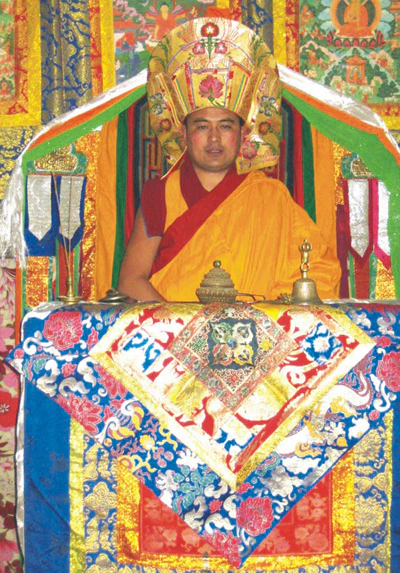
Eight. A temple belonging to one of Hor shul Khenpo Gelek Palsang Rinpoche’s Han Chinese disciples was holding a groundbreaking ceremony for the construction of a great stupa, and many important people were to attend. Many feared that the ceremony would not proceed smoothly because there had been a prolonged drought, no rain had fallen, and strong winds blew every day. They had planned to use water trucks to moisten the ground so that the excavator could begin the earth-breaking ceremony. The temple’s presiding monastic telephoned Hor shul Khenpo Gelek Palsang Rinpoche and prayed for his blessing so that the ceremony would go smoothly. Heavy rain fell that night and stopped the following morning. The weather became pleasantly cool, and the ceremony proceeded smoothly as scheduled. Although the Khenpo was a thousand miles away, many local people directly saw him come to bless them, and numerous exceptional auspicious signs appeared. The moment the ceremony ended, the sun emerged and strong winds began to blow. Many people present felt the inconceivable nature of the Khenpo and the Dharma.
Nine. Hor shul Khenpo Gelek Palsang Rinpoche’s compassion was vast. His pilgrimages in Tibet, extensive lamp offerings, and gilding in Lhasa were all aspirations made for the benefit of beings; he never made the slightest aspiration for himself.
Ten. When the Hor shul Young Monks Buddhist Institute was founded, Hor shul Khenpo Gelek Palsang Rinpoche directly saw Jigme Phuntsok Rinpoche in a state of luminous meditative absorption, coming to bless the institute and teach the Dharma.
Eleven. A prominent family possessed an exceptional statue of Medicine Buddha, said to have been made by celestial beings and personally consecrated while Shakyamuni Buddha was alive. It was regarded as having the same power of blessing as the Jowo Buddha in Lhasa. The family had originally intended to offer it to the supreme Gyalwa Rinpoche, protector of beings in Tibet. Because Hor shul Khenpo Gelek Palsang Rinpoche helped the entire family resolve a great obstacle, however, they offered the statue to Khenpo Rinpoche in gratitude.